Story
자연과 삶의 깊이를 담는 화가
예술로 점철된 삶
AEGOH는 21세기 한국을 대표하는 화가로 그의 작품은 자연과 인간 삶의 조각들을 독특한 시선으로 표현한다. 그의 예술은 전적으로 구상적이며 특히 자연의 영감을 받은 작품들에서 두드러지는 섬세한 감성과 내면의 풍경은 깊은 영혼의 울림을 담아낸다. 경력은 독특한 궤적을 그린다. 1979년 출생하여 도자기 공예를 전공한 후 대통령 비서실에서 첫 직장 생활을 시작했으나, 예술적 충동에 이끌려 일본으로 건너가 화가로서의 정체성을 발견했다. 이후 한국으로 돌아와 자연에 뿌리내린 창작 활동을 이어오고 있다.
이 연대기는 그의 삶과 예술을 시기별로 탐구하며 각 중요 단계를 “장(chapter)”으로 나누어 제시함으로써 그의 예술 여정에 대한 포괄적인 이해를 제공하고자 한다. AEGOH의 여정이 보여주는 예술적 모색, 정신적 스승과의 만남, 그리고 자연과의 깊은 교감이라는 서사 구조는 이러한 연대기적 접근 방식을 통해 명확히 드러날 것이다.
제1장: 예술가의 태동 (1979-2005)
1.1: 1979-대학시절: 출생과 예술 교육
1979년 한국에서 태어났다. 대학에서 ‘도자기 공예’를 전공하며 예술적 기반을 다졌다. 그의 초기 형성에 대한 구체적 기록은 많지 않으나 이 시기에 형성된 입체적 조형 감각과 물질에 대한 이해는 후일 그의 회화 작품에서도 드러나는 중요한 토대가 되었다. 도자기 공예 전공은 그에게 형태와 질감 그리고 공간에 대한 예민한 감각을 심어주었을 것이다. 이러한 초기 예술적 교육은 그가 후일 화가로서 자신만의 독특한 시각 언어를 발전시키는 데 잠재적인 영향을 미쳤을 것으로 보인다.
1.2: 초기 직장-2005: 비서실에서 총영사관으로
양부모님의 권유로 대통령 비서실에서 첫 직장생활을 시작한 그는 안정적인 경력 경로를 밟는 듯했다. 그러나 2005년 그는 중대한 결정을 내린다. 동경에서 살고 있는 여동생 곁으로 가기 위해 ‘주센다이대한민국총영사관’에 지원하여 근무를 시작한 것이다. 이 결정은 표면적으로는 가족적 이유에서 비롯되었으나 후일 그의 예술적 발견과 변화의 시발점이 된다는 점에서 운명적인 전환점이었다. 안정된 직업의 테두리 안에 있으면서도 새로운 문화적 환경에서 자신의 진정한 소명을 발견하기 위한 여정을 시작했다.
제2장: 일본에서의 예술적 각성 (2006-2011)
2.1: 2007-2008: 예술적 스승들과의 만남
2007년은 그의 삶에서 결정적인 해였다. 주센다이총영사관에서 주최하는 ‘한.일 회화’ 전시에서 정물화가 ‘와타나베 다케히코(1933~)’의 작품을 접하게 된 것이다. 이 만남은 화가와의 교류로 이어졌고 TBC방송이 운영하는 문화센터의 서양화 반에서 와타나베의 지도를 받으며 데생수업에 1년간 참여했다.
더욱 중요한 것은 서양화 반 친구의 소개로 그의 평생 정신적 스승이 될 ‘리키마루 요시타카(1937~2012)’ 화가를 만난 것이다. 이 시기 낮에는 총영사관에서 근무하고 밤에는 독학으로 유화를 그리기 시작했다. 와타나베로부터 “누구에게도 배우지 말고 스스로 그려라”라는 조언은 그의 예술적 정체성 형성에 깊은 영향을 미쳤다.
2008년 일본 센다이 cafe Mozart에서 첫 개인전을 열었다. 이는 그가 화가로서 공식적으로 데뷔한 순간이었다. 외국인으로서 그리고 전업 화가가 아닌 상태에서 열린 이 전시는 그의 예술적 열정과 결단력을 보여주는 계기였다.
2.2: 2009-2011: 인정과 시련
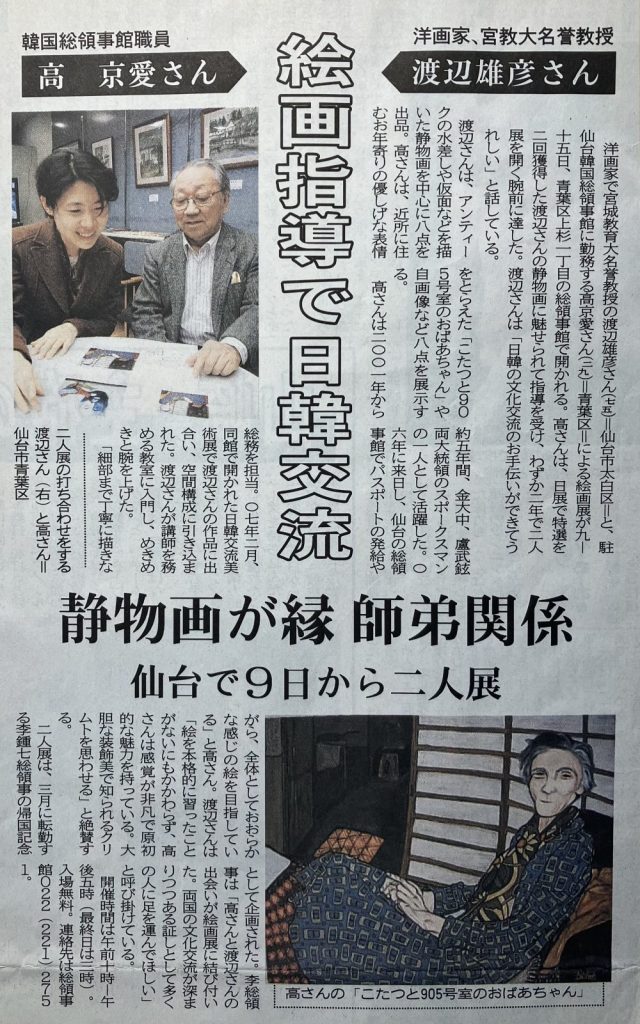
2009년 제73회 가호쿠미술전에 입선하며 공식적인 인정을 받기 시작했다. 심사위원으로부터 “이것이 그림이다”라는 평을 받으며 주목을 받았다. 같은 해 주센다이대한민국총영사관의 초청으로 스승 와타나베 다케히코와 함께 회화전을 열었다.
2010년에는 제74회 가호쿠미술전에서 입상(미야기현교육위원장상)하며 일본 미술계에서의 입지를 더욱 굳혔다. cafe Mozart와 cafe Mozart atelier 두 곳에서 개인전을 열었으며 외국인 화가로서 놀라운 성과를 거두었다. 그러나 2011년 동일본대지진은 그의 삶에 큰 변화를 가져왔다. 남편이 될 이상욱을 처음 만났고 리키마루 요시타카의 부인이자 시인 프리에레누 베르페와 시화전을 준비하는 중에 그녀가 지병으로 사망하는 아픔을 겪었다. 또한 예정되었던 한국에서의 첫 전시(서울 갤러리 로얄)가 동일본대지진으로 무산되는 어려움도 겪었다.
제3장: 예술적 전환과 귀국 (2012-2015)
3.1: 2012-2014: 스승의 별세와 새로운 시작
2012년 정신적 스승인 리키마루 요시타카가 위암으로 사망했다. 임종 시 “너의 스승으로 삼아달라”는 유언을 받는 깊은 교감을 나누었고 리키마루 가족들의 요청으로 고별사를 낭독하기도 했다. 같은 해 이상욱과 결혼하며 새로운 인생의 장을 열었다.
갤러리 토겐도에서 개인전을 열었고 갤러리를 운영하는 미와 미치코의 도움을 받아 <고 리키마루 요시타카 회고전>을 기획하여 개최했다. 스승에 대한 존경과 그의 예술적 유산을 계승하겠다는 의지의 표현이었다.
2013년에는 장남 이준성이 태어났고 2014년에는 갤러리 토겐도에서 또 한 번의 개인전을 열었다. 이 시기 그의 작품은 일본 미술계에서 안정적인 평가를 받고 있었다.
3.2: 2015: 한국으로의 귀환
2015년 10년간 근무했던 센다이 총영사관을 퇴사하고 가족들과 함께 한국으로 귀국했다. 같은 해 차녀 이은솔이 태어났다. 그는 일본에서의 시간을 회고하며 “일본의 십여년은 문화적 지적 풍요로움으로 외롭지 않았다”라고 말했다. 한국으로의 귀환은 그의 예술적 정체성이 더욱 성숙해진 시기와 맞물린다. 일본에서의 경험은 그의 예술적 시각을 넓히고 깊게 했으며 이제 그는 자신의 뿌리가 있는 한국에서 새로운 창작의 여정을 시작하려 했다.
제4장: 한국에서의 예술적 확립 (2016-2021)
4.1: 2016-2017: 한국에서의 첫 개인전과 새 작업 공간
2016년 서울 갤러리 로얄에서 <가미스기의 섬>이라는 제목으로 한국에서의 첫 개인전을 열었다. 그는 이 시기 자신의 예술관을 다음과 같이 표현했다: “그림을 그리기 시작하면서 내가 바라던 ‘나’를 만났고 오직 자신에 이르기 위해 벌걸음을 내디뎠다. ‘섬’은 내가 닿고자 했던 생명을 잉태하는 창조의 열정이다.”
그의 작품에 대한 철학적 접근은 더욱 깊어졌다: “나에게 있어 그림을 그리는 행위는 기록이다. 내 삶에 대한. 그 중심에 늘 사람이 있다. 나는 단지 그것을 기록하고 있는 것이다.”
2017년 그는 자연이 풍요로운 경기도 광주 노곡리에 Aele House를 지어 이주했다. <네임리스건축>의 설계로 지어진 이 공간은 그의 창작과 삶이 조화를 이루는 장소가 되었다.
4.2: 2019-2021: 다양한 예술적 발현과 팬데믹 시기
2019년 네임리스건축과 함께 <코르뷔지에 넌 오늘도 행복하니>를 출간하며 건축에 대한 관심도 표현했다. 또한 서울 갤러리 온그라운드에서 <아홉개의 방 미완의 집> 전시에 참여했다.
2020-2021년은 전 세계적인 코로나 팬데믹 시기였다. 이 어려운 시기에도 갤러리 클립과 Aele Hous에서 홈갤러리 형태로 개인전을 열어 창작 활동을 지속했다. 위기 속에서도 예술적 열정을 유지하고 새로운 형태의 전시 방식을 모색한 시기였다.
제5장: 예술적 성숙과 자연과의 교감 (2022-현재)
5.1: 2022-2023: 다양한 주제의 개인전
2022년 서울 갤러리 클립에서 <봄이 오면> 개인전을 열었고 이어서 갤러리 로얄에서 <유영하는 삶의 조각> 개인전을 개최했다. 김지예 평론가와의 인터뷰에서 “가을 저녁 풀벌레 소리를 듣고 있노라면 자연은 유연한 영혼을 가진 존재임이 틀림없다”라고 표현하며 자연에 대한 깊은 사유를 드러냈다.
2023년에는 서울 갤러리 클립과 함께 <그림과 가구> 전시를 열어 회화를 넘어선 다양한 매체와의 결합을 시도했다. 이 시기 그의 예술은 회화의 경계를 넘어 다양한 생활 공간과 물건들로 확장되어 갔다.
5.2: 2024-2025: 깊은 세계로의 여정
2024-2025년 부산 갤러리 오브제후드와 아난티코브에서 <In the Deep World> 개인전을 열었다. 김지예 평론가와의 서면 인터뷰에서 자연에 대한 그의 철학이 깊이 드러났다.
“숲이 어떤 모습으로 깊은 잠에 빠져드는지 밤의 자연을 만나보고 싶습니다… 자연이 저의 나라라고 한다면 숲은 가정이 되겠지요. 그렇다면 풀과 나무와 새와 바람도 빛도 가족이되겠군요. 자연은 생명 그 자체로 언제나 경이롭습니다. 저는 제가 선택한 나라 안에서 달콤한 행복과 평안을 누리고 있습니다. 창작에서 필요한 ‘모든 것이 전부 여기에 있다’는 믿음과 미학적 정서적 충만함으로 가득 찬 생명의 요새 안에서.”
2024년에는 작업실 공간 Aele Atelier를 완공하며 창작을 위한 전용 공간을 마련했다. 이는 그의 예술적 여정이 더욱 깊고 안정적으로 나아갈 수 있는 기반이 되었다.
자연과 삶의 깊이를 담는 화가
AEGOH의 예술 여정은 본인이 가장 잘 표현한 바와 같이 “오직 자신에 이르기 위한” 여정이었다. 도자기 공예를 전공한 행정직 공무원에서 시작하여 일본에서의 예술적 각성, 귀국 후 한국에서의 활동 확장, 그리고 자연 속에서 깊은 예술적 영감을 찾아가는 과정에 이르기까지 그의 작품은 끊임없이 진화하고 성숙해왔다.
그의 작품 세계의 핵심에는 언제나 “사람”과 “자연”이 있다. 특히 자연을 단순한 풍경이 아닌 “유연한 영혼을 가진 존재”로 인식하는 깊은 통찰은 그의 작품에 특별한 생명력을 부여한다. “할머니의 장례식장을 향해 가는 비행기 안에서 잠이 든 아이”, “중환자실에 누워 있는 엄마를 만나고 집으로 돌아온 남편의 저녁시간”과 같은 소재는 일상의 순간들 속에서 삶의 심오한 의미를 포착하는 그의 능력을 보여준다.
오늘날 그의 작품이 울림을 주는 이유는 그가 자연과 인간의 관계, 삶과 죽음의 순간들을 섬세하게 포착하면서도 그 속에서 위로와 아름다움을 발견하는 능력 때문일 것이다. 자신만의 “가정”이자 “나라”인 자연 속에서 그는 계속해서 더 깊은 창작의 세계로 나아가고 있다.
An Artist Who Captures the Depth of Nature and Life
A Life filled with Art
AEGOH stands as a representative artist of 21st century Korea, whose works express fragments of nature and human life through a unique perspective. Her art is entirely figurative, and particularly in works inspired by nature, her delicate sensibility and inner landscapes convey profound spiritual resonance. Her career follows a unique trajectory. Born in 1979, she majored in ceramic art before beginning her professional life at the Presidential Secretariat. However, led by artistic impulse, she moved to Japan where she discovered her identity as a painter. She later returned to Korea to continue her creative activities rooted in nature.
This chronicle explores her life and art by period, presenting each significant phase as a “chapter” to provide a comprehensive understanding of her artistic journey. The narrative structure of AEGOH’s journey—artistic exploration, meeting spiritual mentors, and deep communion with nature—will be clearly revealed through this chronological approach.
Chapter 1: The Birth of an Artist (1979-2005)
1.1: 1979-College Years: Birth and Artistic Education
Born in Korea in 1979, she built her artistic foundation by majoring in ‘ceramic art’ in college. While there are few specific records about her early formation, the three-dimensional sculptural sense and understanding of materials developed during this period became an important foundation that would later be evident in her paintings. Her major in ceramic art likely instilled in her a sensitive perception of form, texture, and space. This early artistic education potentially influenced her later development of a unique visual language as a painter.
1.2: Early Career-2005: From the Presidential Secretariat to the Consulate General
At her adoptive parents’ recommendation, she began her first job at the ‘Presidential Secretariat,’ seemingly following a stable career path. However, in 2005, she made a significant decision. She applied to work at the ‘Korean Consulate General in Sendai’ to be near her younger sister living in Tokyo. While this decision stemmed from family reasons on the surface, it became a fateful turning point that would initiate her artistic discovery and transformation. Even while within the boundaries of a stable profession, she began a journey to discover her true calling in a new cultural environment.
Chapter 2: Artistic Awakening in Japan (2006-2011)
2.1: 2007-2008: Meeting Artistic Mentors
2007 was a decisive year in her life. At a ‘Korea-Japan Painting’ exhibition hosted by the Sendai Consulate General, she encountered works by still-life painter ‘Watanabe Takehiko (1933~).’ This encounter led to an exchange with the painter, and she participated in drawing classes under Watanabe’s guidance for a year at a cultural center operated by TBC Broadcasting.
Even more importantly, through a friend from the Western painting class, she met ‘Rikimaru Yoshitaka (1937~2012),’ who would become her lifelong spiritual mentor. During this period, she worked at the Consulate General during the day and began teaching herself oil painting at night. Watanabe’s advice to “Don’t learn from anyone else, just paint on your own” had a profound influence on the formation of her artistic identity.
In 2008, she held her first solo exhibition at Cafe Mozart in Sendai, Japan. This marked her official debut as a painter. This exhibition, held as a foreigner and while not a full-time painter, demonstrated her artistic passion and determination.
2.2: 2009-2011: Recognition and Trials
In 2009, she began receiving official recognition when her work was selected for the 73rd Kahoku Art Exhibition. She gained attention with a judge’s comment that “This is what painting is.” That same year, she held a painting exhibition with her mentor Watanabe Takehiko at the invitation of the Korean Consulate General in Sendai.
In 2010, she further solidified her position in the Japanese art world by winning a prize (Miyagi Prefecture Education Committee Chairman’s Award) at the 74th Kahoku Art Exhibition. She held solo exhibitions at both Cafe Mozart and Cafe Mozart Atelier, achieving remarkable success as a foreign painter. However, the Great East Japan Earthquake of 2011 brought significant changes to her life. She met Lee Sang-wook, who would become her husband, and experienced the pain of losing Prérène Belver, Rikimaru Yoshitaka’s wife and a poet, who died from a chronic illness while they were preparing for a poetry and painting exhibition together. She also faced the difficulty of her planned first exhibition in Korea (at Gallery Royal in Seoul) being canceled due to the Great East Japan Earthquake.
Chapter 3: Artistic Transition and Return to Korea (2012-2015)
3.1: 2012-2014: The Passing of a Mentor and New Beginnings
In 2012, her spiritual mentor Rikimaru Yoshitaka died of stomach cancer. At her deathbed, they shared a deep communion with Rikimaru’s last words asking her to “Take me as your mentor,” and at the request of Rikimaru’s family, she delivered the eulogy. That same year, she opened a new chapter in her life by marrying Lee Sang-wook.
She held a solo exhibition at Gallery Togendo and, with the help of gallery owner Miwa Michiko, planned and held a ‘Commemorative Exhibition for the late Rikimaru Yoshitaka.’ This was an expression of respect for her mentor and a determination to carry on her artistic legacy.
In 2013, her first son Lee Jun-sung was born, and in 2014, she held another solo exhibition at Gallery Togendo. During this period, her work was receiving stable recognition in the Japanese art world.
3.2: 2015: Return to Korea
In 2015, she resigned from the Sendai Consulate General where she had worked for 10 years and returned to Korea with her family. That same year, her second daughter Lee Eun-sol was born. Reflecting on her time in Japan, she said, “The ten-plus years in Japan were not lonely due to cultural and intellectual richness.” Her return to Korea coincided with a period when her artistic identity had matured further. Her experiences in Japan broadened and deepened her artistic vision, and now she was ready to begin a new creative journey in Korea, where her roots were.
Chapter 4: Artistic Establishment in Korea (2016-2021)
4.1: 2016-2017: First Solo Exhibition in Korea and New Workspace
In 2016, she held her first solo exhibition in Korea titled <The Island of Kamisugi> at Gallery Royal in Seoul. During this period, she expressed her artistic philosophy as follows: “When I began painting, I met the ‘me’ I had been looking for, and I took steps solely to reach myself. The ‘island’ is the creative passion that gives birth to the life I wanted to reach.”
Her philosophical approach to her work deepened further: “For me, the act of painting is a record. Of my life. At its center, there is always a person. I am simply recording it.”
In 2017, she moved to Nogok-ri, Gwangju in Gyeonggi Province, where nature is abundant, and built Aele House. Designed by <Nameless Architecture>, this space became a place where her creativity and life harmonized.
4.2: 2019-2021: Various Artistic Expressions and the Pandemic Period
In 2019, she published <Le Corbusier, Are You Happy Today?> with Nameless Architecture, expressing her interest in architecture. She also participated in the exhibition <Nine Rooms, Incomplete House> at Gallery On Ground in Seoul.
2020-2021 was the global COVID pandemic period. Even during these difficult times, she continued her creative activities by holding solo exhibitions at Gallery Clip and in a home gallery format at her house in Gwangju, Gyeonggi Province. It was a period when she maintained her artistic passion and explored new exhibition methods despite the crisis.
Chapter 5: Artistic Maturity and Communion with Nature (2022-Present)
5.1: 2022-2023: Solo Exhibitions on Various Themes
In 2022, she held the solo exhibition <When Spring Comes> at Gallery Clip in Seoul, followed by the solo exhibition <Floating Pieces of Life> at Gallery Royal. In an interview with critic Kim Ji-ye, she revealed her deep contemplation of nature, saying, “When I listen to the sounds of insects on an autumn evening, I am certain that nature is a being with a flexible soul.”
In 2023, she held the exhibition <Paintings and Furniture> with Gallery Clip in Seoul, attempting to combine painting with various media. During this period, her art expanded beyond the boundaries of painting into various living spaces and objects.
5.2: 2024-2025: Journey into the Deep World
In 2024-2025, she held the solo exhibition <In the Deep World> at Gallery Objet Hood and Ananti Cove in Busan. Her philosophy about nature was deeply revealed in a written interview with critic Kim Ji-ye:
“I want to meet nature at night to see how the forest falls into deep sleep… If nature is my country, then the forest would be my home, and so the grass, trees, birds, wind, and light would all be family. Nature is always wondrous as life itself. I am enjoying sweet happiness and peace in the country I have chosen. In the fortress of life filled with the belief that ‘everything I need for creation is right here’ and aesthetic emotional fulfillment.”
In 2024, she completed the workspace Aele Atelier, establishing a dedicated space for creation. This became the foundation for her artistic journey to progress more deeply and stably.
An Artist Who Captures the Depth of Nature and Life
AEGOH’s artistic journey has been, as she best expressed it, a journey “solely to reach myself.” From beginning as an administrative civil servant who majored in ceramic art, through her artistic awakening in Japan, expansion of activities after returning to Korea, to finding deep artistic inspiration in nature, her work has continuously evolved and matured.
At the core of her artistic world are always “people” and “nature.” In particular, her deep insight into perceiving nature not as a simple landscape but as “a being with a flexible soul” gives her work a special vitality. Subjects such as “a child asleep on a plane heading to grandmother’s funeral” and “the evening hours of a husband who has returned home after visiting her mother in the intensive care unit” demonstrate her ability to capture profound meanings of life in moments of daily existence.
The reason her work resonates today is likely her ability to delicately capture the relationship between nature and humans and moments of life and death, while discovering comfort and beauty within them. In nature, which is her “home” and “country,” she continues to move toward an even deeper world of creation.
